
What is SEO? A plain-language guide for Swiss SMEs
Short answer
SEO stands for search engine optimisation. According to Google it is about helping search engines understand your content so that your website shows up for relevant searches. For an SME, SEO covers four areas: technology, content, linking and your local presence.
What is SEO? The term turns up in every other quote, and rarely does anyone explain what sits behind it. It often sounds like a trick you can buy.
It is not. SEO is the work of making sure a website is found when somebody searches for what you offer. This article explains the term, shows how Google search works, splits SEO into four manageable areas, and says what a Swiss SME can handle on its own.
What is SEO, exactly?
SEO stands for search engine optimisation. Google itself describes the job as helping search engines understand your content, and helping people find your website (Google SEO starter guide).
What matters just as much is what SEO is not. It is not buying positions: Google states plainly that it does not accept payment to rank a website higher (How Search works). Ads bought through Google Ads appear labelled above or beside the results and do not change the ordinary listings.
SEO is also not a one-off project. Competitors change their sites, Google changes its systems, and your own services move on. A realistic plan is an initial investment followed by regular upkeep.
How does Google search work?
In three steps. Google describes them as crawling, indexing and serving search results (Google: how Search works).
Crawling: automated programmes download pages they find through links or a submitted sitemap. Indexing: Google analyses what a page is about and stores it in the index. Serving: when somebody searches, Google looks through the index for matching pages and sorts them by quality and relevance.
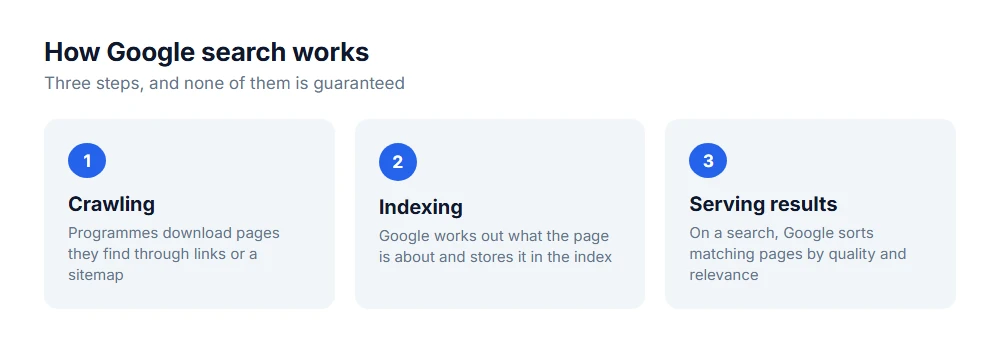
Two points matter most for an SME: Google guarantees neither crawling nor indexing, and an indexed page does not automatically appear in the results. That is why SEO starts with the technology, not with the copy.
In practice: a new page is found mainly through links from pages Google already knows. If server errors, a rule in the robots.txt file or a noindex instruction in the source code block access, the best copy in the world changes nothing. An audit checks exactly these points first.
The four areas of SEO
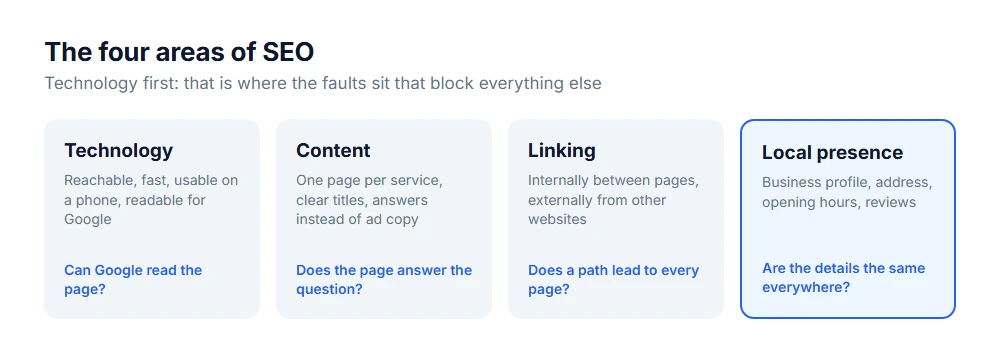
Instead of a long list of measures, it helps to split the work into four areas.
Technology. Is the site reachable, fast and usable on a phone? Can Google read it? This is where the faults sit that block everything else.
Content. Does every service have a page that answers the customer's question? Clear page titles belong here. A good title, in Google's words, is unique to the page, clear and concise.
Linking. Internally, so that Google and people get from one page to the next. Externally, because the vast majority of new pages Google finds come from links.
Local presence. The Google Business Profile, opening hours, address, reviews. For a business with a catchment area this is the most important area of all.
Our article on how Google finds a website sets out a sensible order of work.
Two terms from quotes fit in here. On-page SEO covers everything on your own website: technology, content, titles and internal links. It is the part you fully control, and the part where work on your own pages begins.
Off-page SEO means everything outside: links from other websites, directories, mentions. Here you are not the only one deciding, so building links takes longer and needs real occasions such as partnerships, local clubs or expert contributions.
Local SEO: how Google sorts results in Maps
For local results Google names three factors: relevance, distance and prominence (Google: improve your local ranking).
Relevance means how well the profile matches the search, and complete information helps. Distance is how far you are from the person searching. Prominence draws on mentions across the web as well as the number and quality of your reviews.
That leads to a short list for a business in central Switzerland:
- Verify the business profile and fill it in completely, including the category and special opening hours.
- Reply to reviews, including the uncomfortable ones.
- Upload your own photos rather than stock images.
In the same document Google notes that a better local ranking cannot be demanded, not even for payment. Anyone who promises it is promising something they cannot deliver.
What does SEO mean for AI answers?
The same as before, with one addition. In its guide to generative AI search Google writes that established SEO practices remain relevant, and that optimising for AI search is, from Google Search's point of view, optimising for search in general (Google: generative AI search guide).
No new machine-readable files, AI text files or extra markup are needed for this, according to Google. Structured data is not a requirement either, though it is still recommended for rich results.
What Google does stress: original content with a perspective of your own rather than a repeat of what is already online. For an SME that means your own prices, your own processes, your own answers to customer questions.
What is behind the hype around "GEO", and what is not, we unpicked in SEO and GEO.
What can you do yourself?
A great deal. Google writes that a small local business can probably do most of the work itself (Google: do I need an SEO?).
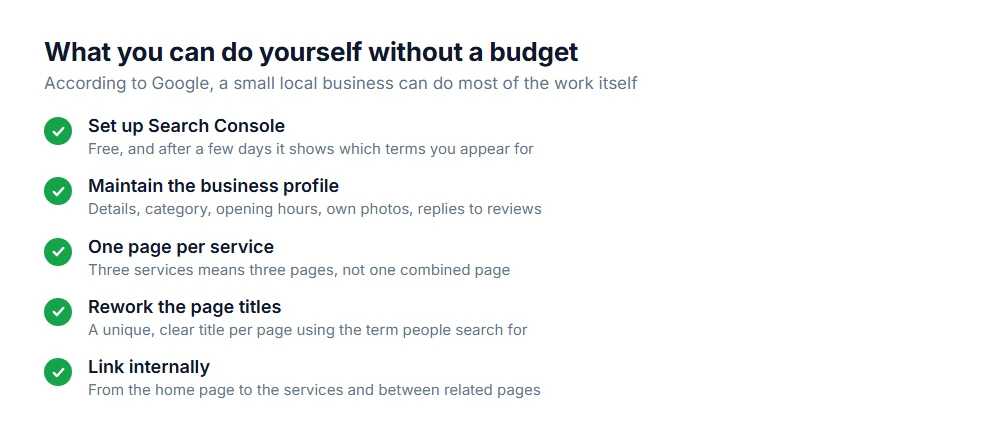
These five steps need no budget, only time:
- Set up Search Console. It is free and shows which terms you already appear for.
- Maintain the business profile. Details, photos, opening hours, reviews.
- One page per service. Three services means three pages, not one combined page.
- Rework the titles. A unique, clear title per page using the words your customers search for.
- Link internally. From the home page to the service pages, and between related pages.
Patience is part of it: according to Google some changes take effect within hours, others only after several months.
When is help worth it, and what comes next?
When competition in your field is strong, when the site has technical problems, or when time is short. Our guide prices: a one-off audit with a priority list from a few hundred francs, ongoing support from around CHF 500 a month. Our article on what SEO costs compares the pricing models.
A sensible middle way: buy the audit and work through the list yourself.
Start in this order:
- Set up Search Console and collect two weeks of data.
- Write down the three search terms your customers actually use.
- Check whether each one has a page of its own.
- Compare the figures in Search Console after three months.
How we go about it is described on our SEO page.
Frequently asked questions
What is a keyword?
Does every page of my website need SEO?
Do I need SEO if I already run Google Ads?
What is SEO marketing?

Written by
Jonathan Lao
Managing Director, PortalWeb GmbH
Jonathan Lao is Managing Director of PortalWeb GmbH, based in Altdorf in the canton of Uri. He supports Swiss SMEs in the conception and development of corporate websites and online stores, as well as in search engine optimisation and online marketing.