
How to create a website: 8 steps for a Swiss business
Short answer
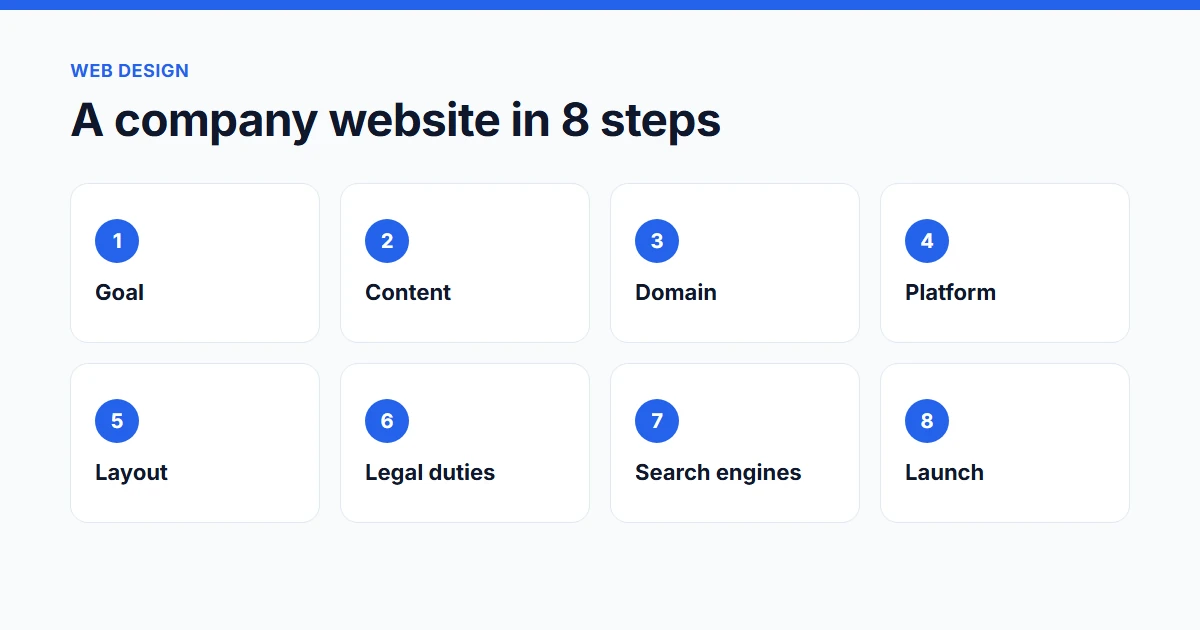
To create a website in Switzerland you work through eight steps: set a goal, gather content, register a domain, choose a platform, design the pages, add a legal notice and privacy statement, prepare for search engines and go live. We budget from around CHF 800 and four to six weeks for a simple company website.
Building a website sounds like a technical job. Most of it is decided before anyone touches a screen: what the site is for, which content it needs, and who writes the copy.
This article walks through the eight steps behind a company website in Switzerland, from the goal through domain, platform and layout to the legal notice, data protection and launch day. Each step says what has to be decided and whether you can handle it yourself.
How to create a website: the eight steps
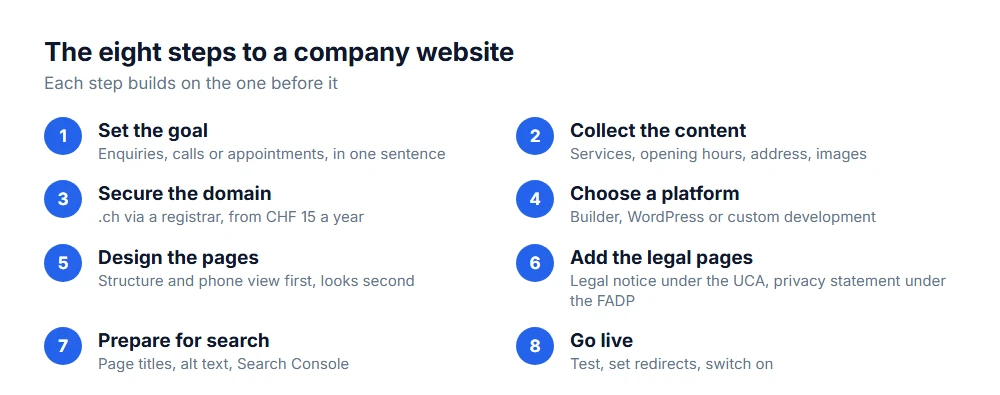
A company website comes together in eight steps: goal, content, domain, platform, layout, legal duties, search engines, launch. The order is not arbitrary, because each step builds on the one before it.
The Swiss federal SME portal describes the same core sequence: pick the domain name and check that it is free, build the site, then add content and design, and only at the end think about selling online (SME Portal of the Swiss Confederation).
For a straightforward company website we allow four to six weeks from the kick-off meeting, and two to three weeks for smaller projects. The biggest factor is usually you: copy, images and sign-off. Our article on how long a website takes breaks the schedule down.
Steps 1 to 3: goal, content and domain
Start with a job to be done, not with a layout. Write one sentence about what the site should deliver: enquiries through a form, phone calls, job applications, booked appointments. That sentence is how you judge it later.
Step 2, the content. The SME portal lists what belongs on a good site: your products and services, opening hours, phone number, postal address and email address. Add trust signals such as references, team portraits or certificates. Collect copy and images before the design work starts.
Step 3, the domain. You do not register a .ch address with the registry itself but through an accredited registrar. Switch runs the registry on behalf of the Federal Office of Communications (nic.ch). Registrars set their own prices: at Hostpoint a .ch domain costs CHF 5 in the first year and CHF 15 a year from the second, VAT included (Hostpoint, checked on 15 October 2026).
Steps 4 and 5: choose a platform and design the pages
There are three routes: a website builder, a content management system such as WordPress, or custom development. A content management system is software that lets you change content yourself without writing code.
The SME portal calls website builders and WordPress inexpensive, efficient and user-friendly, and recommends bringing in specialists for complex, dynamic websites. Which system suits which business is compared in our article on WordPress, Shopify and custom development.
Step 5, the layout. Structure first, looks second: which pages exist, what they are called in the navigation, what appears first on a phone. The SME portal suggests the logo and slogan top left, the phone number top right, breadcrumb navigation that shows the path to the current page, and an internal search once there is a lot of content. Check every page on a phone first.
Step 6: legal notice and data protection in Switzerland
Two laws apply to almost every company website. The Unfair Competition Act requires anyone who offers goods, works or services online to give clear and complete details of their identity and contact address, including their email address (UCA Art. 3 para. 1 let. s, SR 241, as of 1 January 2025).
The duty is tied to offering something online, not to every page on the internet. Where exactly the line runs is open to interpretation. We therefore recommend that every business publish a legal notice with the company name, address, email address and phone number.
Privacy statement. The Data Protection Act requires you to inform people appropriately when you collect personal data, as a minimum about your identity and contact details, the purpose of the processing and the recipients. If data goes abroad, you name the country as well (FADP Art. 19, SR 235.1). A contact form or analytics software is enough to trigger this.
Legal position checked in October 2026. This article is not legal advice.
Steps 7 and 8: get found and go live
Search engine optimisation, in Google's own words, is about helping search engines understand your content. Google finds most websites by itself: normally you need to do nothing beyond publishing your site on the web (Google SEO starter guide). There is no guarantee, though: Google states that neither crawling nor indexing is assured (How Search works).
Three things are worth doing at launch: a unique, clear title for every page, descriptive alt text on images, and a Google Search Console account to watch how the site performs. Our article on what SEO is explains what sits behind that.
Step 8, the launch. Before you switch the site on, check every page on a phone, send the contact form once yourself, and set up a redirect from each old address to the new one. After launch, changes need time: some take effect within hours according to Google, others only after several months.
What does it cost to create a website?
Our guide prices: a simple company website with a handful of pages starts at around CHF 800. A larger site with a custom design, several service areas and SEO basics typically runs from CHF 3,000 to 8,000.
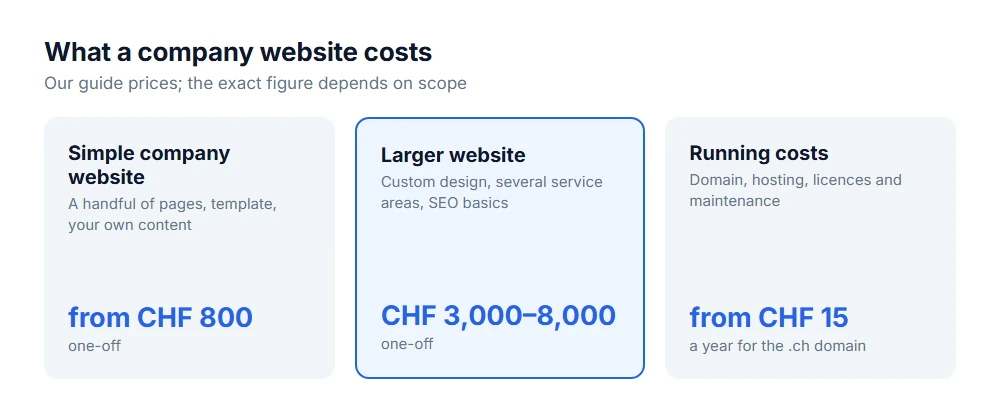
On top come running costs: the domain from CHF 15 a year, hosting, any licences and maintenance. A website builder shifts cost from one-off to monthly and takes work off your hands in return.
We only quote an exact price after a conversation, because it depends on scope. What makes up a quote is set out in our article on what a website costs.
Do it yourself or hire an agency?
This question is best answered step by step rather than for the whole project. A split that works for small businesses:
| Step | Doable yourself | Better with help |
|---|---|---|
| Goal and content | Yes, only you know the business | Editing the copy |
| Domain | Yes | Moving an existing address |
| Platform and layout | Builder yes | Custom design, several languages |
| Legal duties | Check a template | Shop, bookings, sensitive data |
| Search engines | Basics yes | Strong competition in your field |
| Launch and upkeep | Content yes | Technology, updates, security |
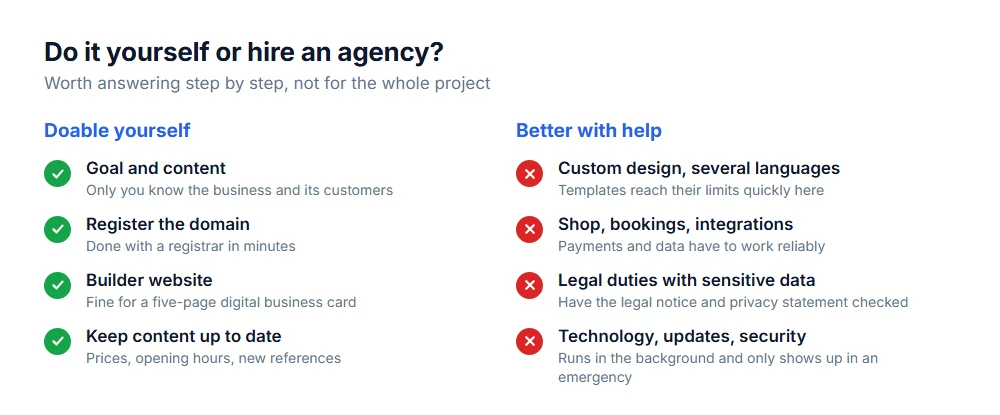
A five-page digital business card is fine with a website builder. As soon as bookings, a shop, several languages or a link to existing systems come into play, the work grows quickly, and the SME portal recommends specialists at that point too. The trade-off with numbers is in our article on whether to build a website yourself or hire an agency.
How to get started
- Write down the goal. One sentence with something measurable, for example enquiries per month.
- List the pages. Which pages do you need, and which texts and images are still missing?
- Secure the domain. Check your preferred name with a registrar and register it now, even if the launch comes later.
- Choose a route. Test a website builder, or get two or three quotes and compare scope, rights to the files and running costs.
- Set a date. A launch date keeps the project moving.
How we build a company website, from structure to handover, is described on our web design page.
Frequently asked questions
What is the difference between a website, a web page and a homepage?
Can I create a website for free?
How many pages does a company website need?
How do I find a good domain name?

Written by
Jonathan Lao
Managing Director, PortalWeb GmbH
Jonathan Lao is Managing Director of PortalWeb GmbH, based in Altdorf in the canton of Uri. He supports Swiss SMEs in the conception and development of corporate websites and online stores, as well as in search engine optimisation and online marketing.