
Vacation rental booking system: the costs compared
Short answer
A vacation rental booking system comes in three forms: a platform such as Airbnb, a plugin inside your own website, or a system of your own. Platforms charge commission, at Airbnb usually 15.5 percent as a host-only fee. Our own booking systems start at CHF 1,500 plus CHF 20 to 50 a month.
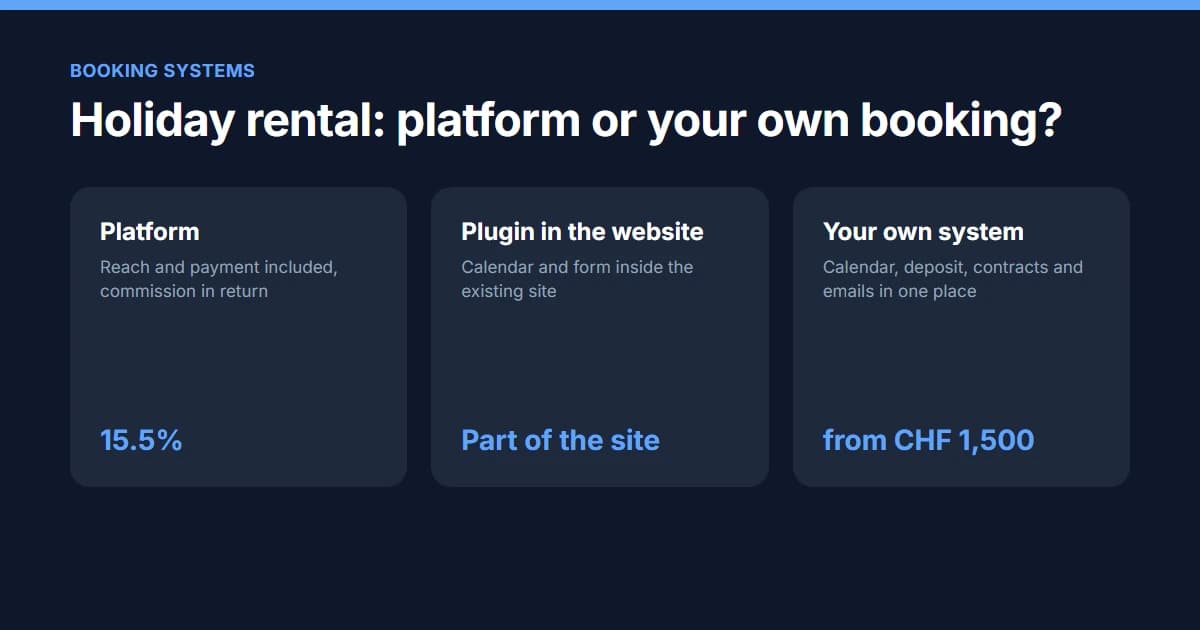
Before the winter season the question comes round again: is Airbnb enough, or is it worth running your own booking page? The answer depends less on taste than on two numbers, the commission and the share of guests who would book with you directly anyway.
This article compares the three routes using official fees, works through an example from central Switzerland, and covers what calendars, payment, tourist tax and VAT mean here.
Which vacation rental booking system fits?
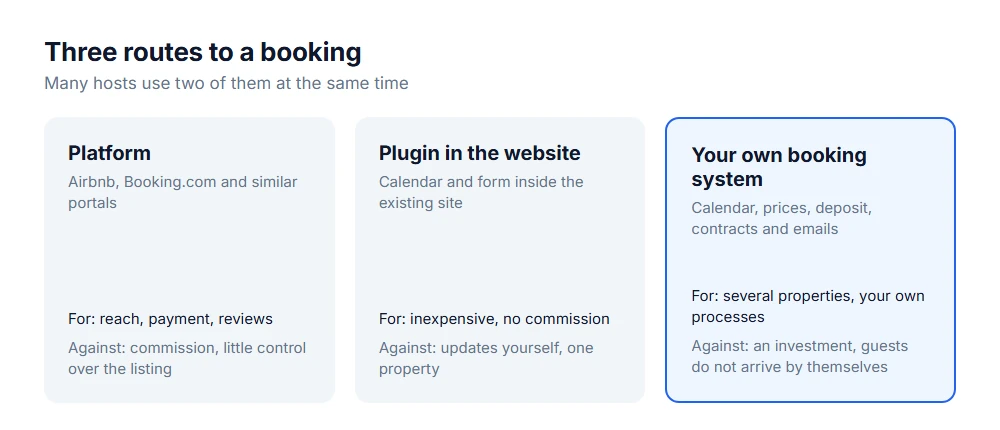
There are three routes, and many hosts use two of them at the same time.
Platforms such as Airbnb or Booking.com bring reach, payment handling and reviews. In return they keep a commission and decide how your listing looks.
A plugin inside your own website adds a calendar and a booking form to an existing site. It is the cheapest route of your own, but it needs maintenance and suits a single property best. Whether you take on that maintenance is the same trade-off as for the rest of the site: do it yourself or hire an agency.
A booking system of your own ties together calendar, prices, deposits, contracts and emails. It pays off once several properties, seasonal rates or extra services come into play.
A fourth building block is the channel manager, software that keeps your calendar in step across several portals. It does not replace a booking system; it prevents double bookings.
What do Airbnb and Booking.com cost?
Airbnb has two models. Under the split fee most hosts pay 3 percent and guests pay a further 14.1 to 16.5 percent of the subtotal. Under the host-only fee the host carries everything: most pay 15.5 percent, the rest usually 14 to 16 percent. For many traditional hospitality businesses this model is mandatory (Airbnb help centre, checked on 15 October 2026).
Booking.com publishes no standard rate; it sits in your contract. There is an official assessment all the same: on 21 May 2025 the Swiss Price Supervisor ruled that the commission rates charged to Swiss hotels are abusively high and must fall by just under a quarter on average. The company can appeal to the Federal Administrative Court (Swiss Price Supervisor, media release of 21 May 2025).
One point matters for your own pricing: since 1 December 2022, parity clauses imposed by booking platforms on accommodation businesses count as unfair competition in Switzerland (UCA Art. 8a, SR 241). You may therefore be cheaper on your own site than on the portal.
Direct booking, worked through
An example with round figures: a holiday flat in central Switzerland, 120 guest nights a year at CHF 180, so CHF 21,600 of revenue spread across roughly 30 bookings.
Through the platform: 21,600 × 15.5 percent = CHF 3,348 in fees per year.
Through your own site: a booking system starts at CHF 1,500 with us, plus CHF 20 to 50 a month for the booking service, so CHF 240 to 600 a year. Assume you take TWINT under a contract of your own: remote transactions then cost 1.35 percent, with a further 30 centimes per transaction when a payment link is used (TWINT schedule of prices and services, July 2026). That makes 21,600 × 1.35 percent = CHF 291.60 plus 30 × 0.30 = CHF 9, so around CHF 300.
First year: 1,500 + 600 + 300 = CHF 2,400. From the second year: CHF 900.
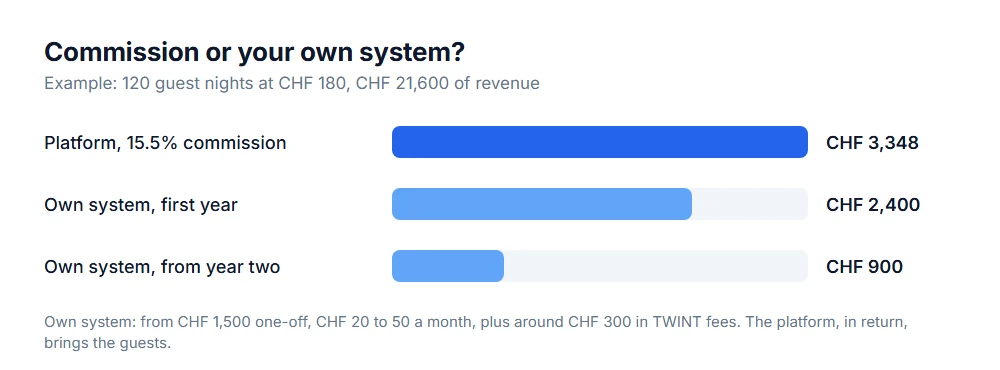
In other words: once around CHF 15,500 of revenue runs through your own site (2,400 ÷ 15.5 percent), your own system is cheaper in the first year. From the second year, around CHF 5,800 is enough.
The honest counter-argument: the platform brings the guests, your own site does not. Anyone starting out usually begins on a portal and builds up direct bookings alongside.
Keeping calendars in step
As soon as one property sits on two channels, you need calendar synchronisation. The usual method is iCal, a calendar exchange format: each portal provides an address ending in .ics, and the others read it regularly.
Airbnb names VRBO, Booking.com and Tripadvisor for this and refreshes linked calendars automatically about every three hours (Airbnb help centre on calendar syncing).
That interval is the catch. Between two refreshes the same night can be booked twice. Three measures help:
- Block preparation days between stays, which takes the pressure off tight changeovers.
- Make one channel the lead, usually your own site, and enter phone enquiries there immediately.
- Use a channel manager once more than two portals are involved.
If you only let directly, you need none of this: there is exactly one calendar.
Payment, tourist tax and VAT
Three things need deciding on payment: deposit or full amount, payment methods and the cancellation rule. A deposit at booking with the balance before arrival is common and can be mapped in any booking system. TWINT, cards and invoices can be combined.
Tourist tax. This is set at cantonal and communal level. In the canton of Lucerne, communes may charge it for every overnight stay in a holiday flat, per guest night, including when the booking comes through a third party. Owners may also pay an annual lump sum, and the commune sets the amount (Act on tourism levies and contributions, SRL No. 650, §§ 15 and 17, in German).
VAT. Accommodation falls under the special rate of 3.8 percent, which runs until the end of 2027 at the latest (VAT Act Art. 25 para. 4, SR 641.20). You only become liable once turnover passes CHF 100,000 a year; below that you are exempt.
Legal position checked in October 2026. This article is not legal advice.
Plugin or your own system?
The rule of thumb: a plugin is enough for one property with simple pricing, and a system of your own pays off from several properties or unusual processes.
| Plugin in the website | Own booking system | |
|---|---|---|
| Properties | One or two | Several, including variants |
| Prices | Season and weekend | Tiers, surcharges, discounts |
| Payment | Usually one provider | Deposit, balance, TWINT |
| Upkeep | Updates yourself | Looked after |
| Guide price | Part of the website | from CHF 1,500, 4,000 to 9,000 with payments and a team |
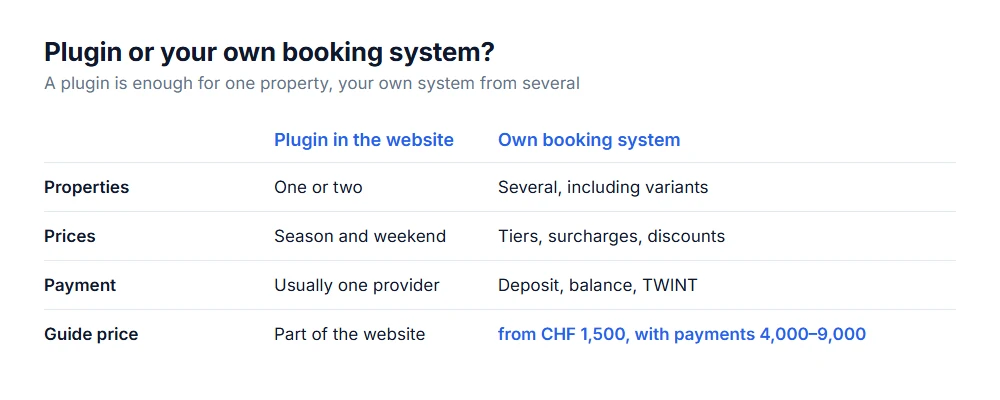
Once payments, several staff with their own calendars or a link to existing systems come in, our range is CHF 4,000 to 9,000. Which website platform sits underneath is compared in our article on WordPress, Shopify and custom development.
If the website itself does not exist yet, plan both together: booking belongs inside the structure of the site, not bolted on beside it. Our web design page describes how we build one.
How to get started
- Collect the figures. Last year's guest nights and average rate, plus the commission you paid.
- Estimate the direct share. How many guests return or call you? That is your reliable direct revenue.
- Do the maths. Set direct revenue times the commission rate against the cost of your own system, as in the example above.
- Start small. Calendar and enquiry form first, payment later.
- Keep both. The portal for new guests, your own site for regulars.
What a website with booking costs overall is set out in our article on what a website costs. How we build booking flows is described on our online booking system page.
Frequently asked questions
Is there a free booking system for holiday rentals?
May I be cheaper on my own website than on Airbnb?
What is a channel manager and do I need one?
How many bookings make an own system worthwhile?

Written by
Jonathan Lao
Managing Director, PortalWeb GmbH
Jonathan Lao is Managing Director of PortalWeb GmbH, based in Altdorf in the canton of Uri. He supports Swiss SMEs in the conception and development of corporate websites and online stores, as well as in search engine optimisation and online marketing.