
How does Google find a website?
Short answer
For a website to be found on Google it has to clear three hurdles: Google must discover it (crawling), take it in (indexing) and rate it as the best answer to a search query (ranking). Most sites don't fail on the technical side but because their content doesn't answer a concrete question.
We get this question more often than any other. Usually from someone who has just paid for a new website and wonders why nothing shows up when they search for what they offer.
The answer is uncomfortable: putting a website online does not mean it will be found. Those are two different things. Three steps sit in between, and it can fail at each one.
How does Google pick up a website in the first place?
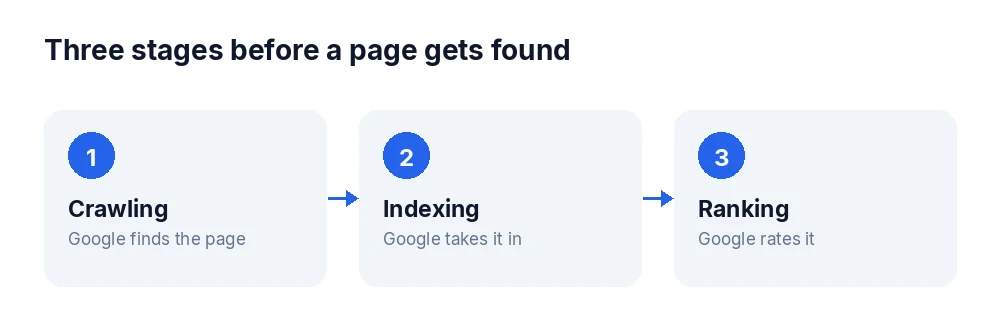
Google works in three stages, and a page has to pass all three.
Crawling. A program from Google, the crawler, visits your site and reads it. It finds you through links from other sites or through your sitemap – a file listing all your pages. Without one of those two routes, Google simply doesn't know you exist.
Indexing. Google decides whether the page goes into the index. That isn't a formality. Pages with very little content, duplicates, or pages excluded technically don't make it in. No index, no ranking – for search, the page doesn't exist.
Ranking. Only now does position come into play. Google compares your page with every other page in the index and decides which best answers a given query.
Most businesses that come to us don't have a crawling problem. Their site is indexed. It just sits at position 40, because twenty other pages answer the same question better.
How do I check whether my site is in the index at all?
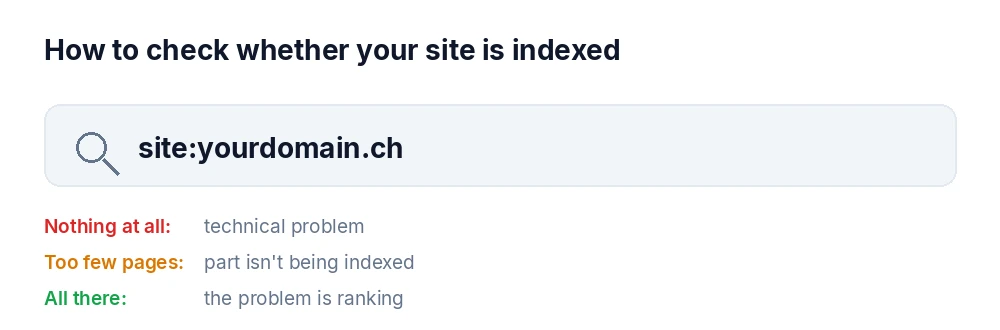
In ten seconds: type site:yourdomain.ch into Google. What you see is a rough
list of the pages Google knows about.
If nothing comes back, you have a technical problem. If far fewer pages appear than you have, part of your site isn't being indexed. Both are fixable.
For more detail, use Google Search Console. The tool is free, and every business with a website should have it set up. It shows you not only which pages are indexed but also which search terms you already appear for and how often people click. That data is the starting point for any sensible measure.
Why can I find my site but nobody else can?
Because you search differently from your customers.
You type your company name and find yourself in first place. That only proves Google knows you. But your customers don't type your company name – they don't know you yet. They type what they need: "plumber Altdorf", "have a website built", "tax return Uri".
Those search terms decide whether you get found. And that's exactly where others sit ahead of you.
The practical test: ask three people outside your business what they would search for if they needed your service. The answers almost always differ from what you expected.
What decides your position?
Google names over two hundred factors, but for an SME four of them matter.
The content answers the question. By far the most important point. A page saying "we offer tailor-made solutions" answers no question. A page explaining what something costs, how long it takes and who it suits does.
Technology isn't in the way. Loading time, usability on a phone, a clean page structure. This won't push you forward, but it holds you back when it's missing. Over half of all visits come from a smartphone, and Google primarily assesses the mobile version. Google describes the fundamentals in detail in the SEO starter guide from Google Search Central.
Others link to you. Google treats links from topically related sites as recommendations. For a local business that means industry associations, regional portals and partner companies – not purchased entries in link directories. How that works properly is covered under offpage SEO.
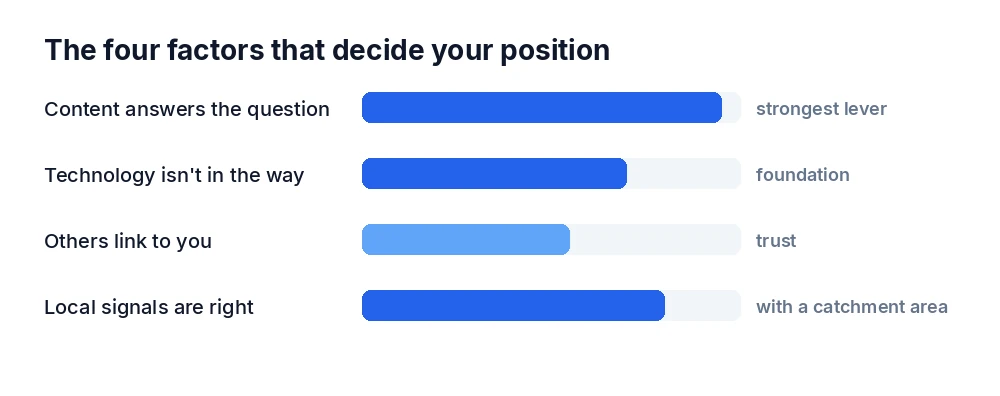
Local signals are right. If you have a catchment area, your Google Business Profile is often more important than the website itself. More on that shortly.
How long until something happens?
With technical improvements we see first effects after four to eight weeks. Google has to revisit the page, record the change and re-evaluate it.
Content changes take longer. When a page is rewritten or substantially expanded, Google needs time to reassess its relevance – typically three to six months.
A new domain with no history takes longest. Expect six to twelve months before anything moves for competitive terms. With local terms and little competition it's faster, sometimes within eight weeks.
Anyone promising you a position within two weeks is either selling paid ads or doesn't know better.
What delivers results fastest?
For a business with a catchment area the order is fairly clear.
First the Google Business Profile. It's free, set up in an hour, and it decides how you appear in the map results. Many businesses have a profile, but hardly anyone completes it: opening hours, services, photos, posts. A complete profile regularly beats a prettier website.
Then the page titles. The title is the blue text in the search result and one of the strongest single factors. If it says "Home" or just your company name, you are wasting it. It should contain what you do and where.
Then the content. This is where onpage SEO comes in: one dedicated page per important service, answering the questions customers actually ask. A page listing every service in two sentences ranks for none of them.
Finally the linking. Both internally between your own pages and externally from other sites to you.
Why isn't ranking enough in 2026?
Because a growing share of searches end without a click. Google answers directly in the results, AI systems summarise. Sitting at position three but appearing in none of those answers means losing out.
What helps is fortunately the same thing that has always helped with ranking, just more consistently: clear answers high up on the page instead of hidden behind an introduction. Concrete figures instead of platitudes. And a structure machines can read.
In practice: if a page answers the question "what does it cost?", the figure belongs in the first paragraph, not the fourth.
What Google officially says about optimising for AI answers is explained in GEO vs SEO: What really helps you appear in AI answers.
What you can do this week
Three things that cost nothing but time:
- Type
site:yourdomain.chinto Google. Are all the important pages there? - Set up Google Search Console if you haven't. After a few days it will show you which terms you already appear for.
- Complete your Google Business Profile. Opening hours, all services, at least five current photos.
After that you know where you stand – and that's the prerequisite for everything else. If you want to know which two or three steps would achieve the most in your case, take a look at our page on search engine optimisation or get in touch for a free initial assessment.
What professional SEO support costs is covered in How much does SEO cost in Switzerland?
Frequently asked questions
How long does it take for a new website to appear on Google?
Do I have to pay for good Google rankings?
Why do competitors rank above me even though my site looks better?
Do I need a blog to get found?
What's the most common mistake with new websites?

Written by
Jonathan Lao
Managing Director, PortalWeb GmbH
Jonathan Lao is Managing Director of PortalWeb GmbH, based in Altdorf in the canton of Uri. He supports Swiss SMEs in the conception and development of corporate websites and online stores, as well as in search engine optimisation and online marketing.