
GEO vs SEO: What really helps you appear in AI answers
Short answer
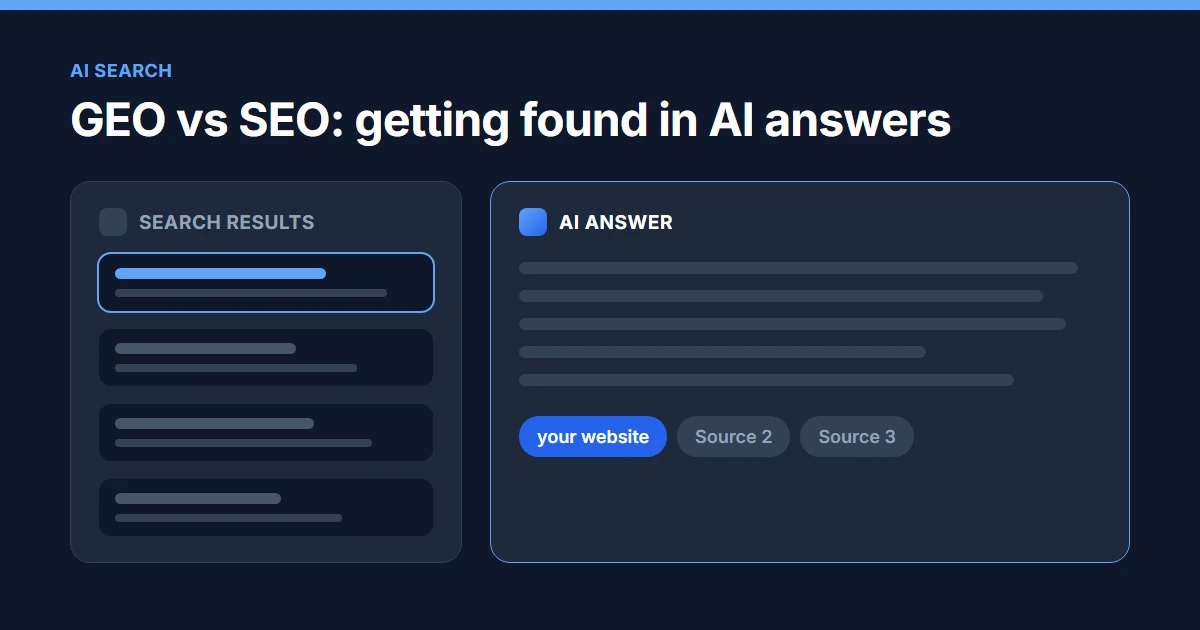
GEO vs SEO isn't an either-or: both aim to get your website found, GEO as a source in AI answers such as Google's AI Overviews or ChatGPT. Google officially says that optimising for generative AI search is still SEO. What matters are indexable pages and original, concrete content, not special files.
Anyone searching on Google in Switzerland increasingly gets an answer put together by AI first. And people use such services themselves: according to the Swiss Federal Statistical Office, 47 percent of the population used generative AI in 2025 (FSO, in German).
No wonder a new acronym is doing the rounds: GEO. Below you'll find what's behind the two terms, what Google officially says and which measures are genuinely worthwhile for an SME.
What is the difference between SEO and GEO?
SEO is about being found in Google's list of results. GEO, short for generative engine optimisation, is about appearing as a source in an AI answer: in Google's AI Overviews, in AI Mode, in ChatGPT or in Perplexity. The term was coined by a research group that studied how content becomes visible in such answers (Aggarwal et al.).
Google doesn't see it as a new discipline. In its own guide, Google says that optimising for generative AI search is optimising for the search experience, and "thus still SEO" (Google Search Central).
Here is GEO vs SEO at a glance:
| SEO | GEO | |
|---|---|---|
| Visible as | a result in the results list | a source in an AI answer |
| Measurement | positions, impressions, clicks | AI impressions, citations, visits from AI services |
| Foundation | indexable page with good content | the same |
Other names for the same topic are generative search engine optimisation, AEO for answer engine optimisation, or simply AI SEO.
What are AI Overviews and AI Mode?
Two features of Google Search that are already available in Switzerland.
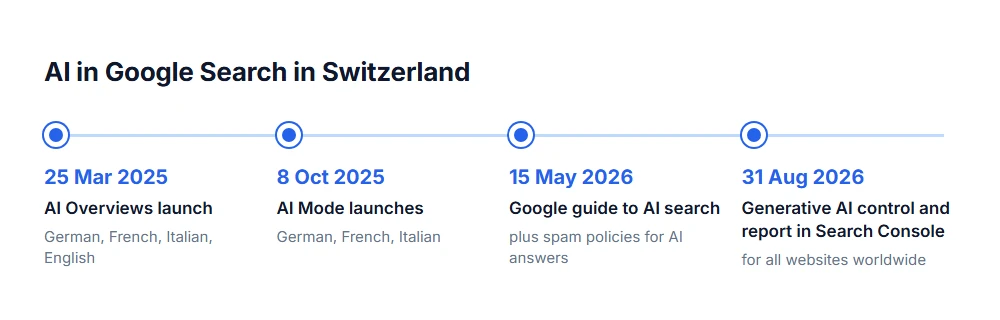
AI Overviews. A summary above the regular search results, with links to the sources. Google launched them in Switzerland on 25 March 2025, in German, French, Italian and English (Google).
AI Mode. A separate search interface where you ask questions in a dialogue and get more detailed answers. It has been available in Switzerland since 8 October 2025, in German, French and Italian (Google, in German).
Both draw on Google's index. A page that Google hasn't indexed, or that isn't allowed to show a snippet, therefore can't appear as a source either. A snippet is the short text extract Google shows below a search result. The website also mustn't be excluded from AI features in Search Console, Google's free tool for website owners.
What do AI answers mean for clicks to your website?
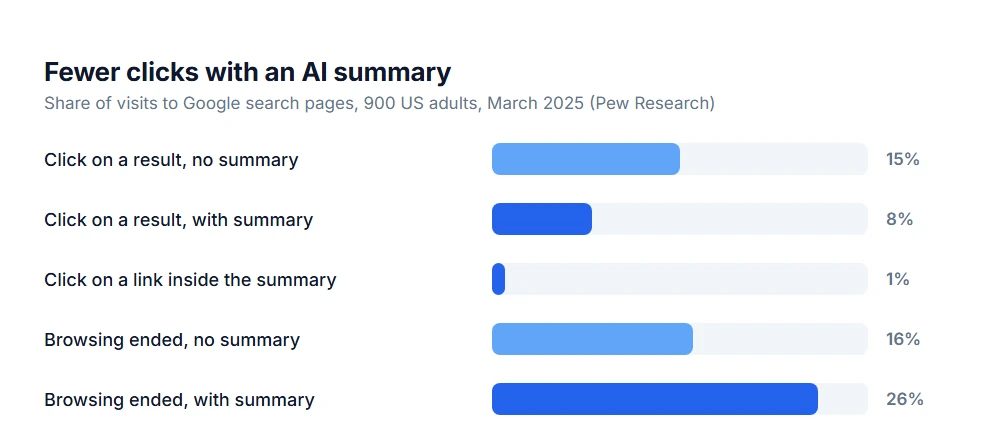
Fewer clicks per search. That's what an analysis by Pew Research in the US shows: people who saw an AI summary clicked on a regular search result in only 8 percent of visits to Google search pages, compared with 15 percent without a summary. A link inside the summary itself was clicked in just 1 percent of visits (Pew Research Center).
With a summary, browsing also ended entirely more often, in 26 rather than 16 percent of visits. The data is based on the browsing activity of 900 adults in March 2025. We haven't found comparable figures for Switzerland.
That doesn't mean Google disappears as a channel. But visibility increasingly belongs to whoever is cited as a source, even if fewer people click through.
What does Google officially say about optimising for AI answers?
On 15 May 2026 Google published a dedicated guide and clarified that its spam policies also apply to AI answers. The key points:
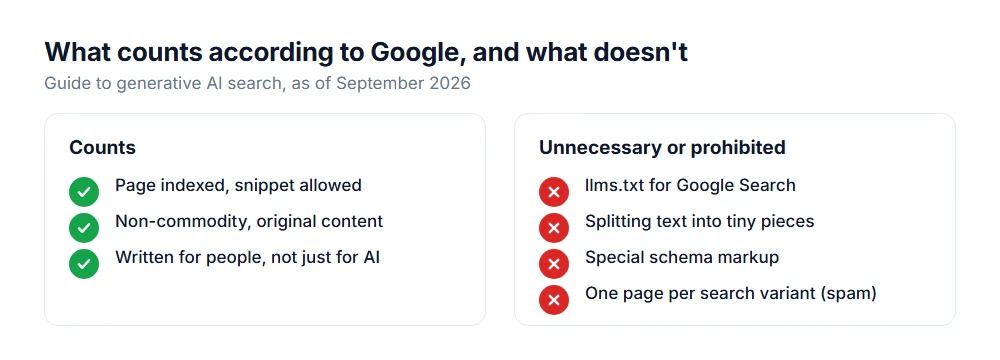
- The basics stay the same. A page must be indexed and eligible to appear with a snippet in search results. The website mustn't be excluded from AI features in Search Console.
- Original content counts. Google talks about "non-commodity content": knowledge and perspective that isn't on a hundred other pages.
- Write for people. Pages should be created for your audience, not just for generative AI search.
- No llms.txt needed. Google Search doesn't use such text files, which prepare content specifically for AI.
- No bite-sized chunks. Content doesn't have to be broken into tiny pieces.
- No special schema. Structured data, meaning extra markup in the code, isn't required for generative AI search.
- No page per search variant. Creating pages for search variants primarily to manipulate rankings or AI answers violates Google's spam policies.
What do studies show about content that AI systems cite?
This is a young field of research, and many figures show correlations, not proof.
In the original GEO study, content became up to 40 percent more visible in AI answers when it was enriched with quotations, statistics and cited sources. Simply repeating keywords, on the other hand, performed worse.
The study has limits, though. Its methods were tested on a simulated AI search system based on GPT-3.5 and on Perplexity, not on Google's AI features. The authors themselves write that the methods may need to adapt as these systems evolve. And pages that already ranked first in Google Search even lost visibility when additional citations were added.
The conclusion is unspectacular: concrete figures, your own assessments and well-sourced statements help, whether a person or an AI reads the text. That's exactly what Google asks for anyway.
Which SEO agency also understands GEO?
One that doesn't promise you anything outside its control. These questions help when choosing:
- Does it rely on Google's documentation or on secret tips?
- Does it work with Search Console? Since 31 August 2026, Google has offered all websites worldwide a setting and a report on AI features there.
- Does it promise citations in AI answers? Nobody can guarantee that, any more than anyone can guarantee first place on Google.
- Does it plan mass pages for search variants? That violates Google's spam policies.
More red flags in SEO offers, and what proper work costs, are covered in How much does SEO cost in Switzerland?
How we work is described on our SEO agency page.
How do you optimise your website for AI answers? Checklist for SMEs
Worth doing:
- Check indexing. Are your important pages on Google? How to check is explained in How does Google find a website?
- Don't block snippets or AI features. If you prevent snippets or exclude your website in Search Console, you can't appear as a source in AI Overviews.
- Give the answer early. The most important statement belongs at the start of a page and of every section.
- Your own Swiss facts. Prices in Swiss francs, processes, the legal situation and examples from your region.
- Cite sources and figures. Well-sourced statements are more credible, for people and for AI.
- Update content for real. Add new figures rather than just changing the date.
- Earn genuine mentions. Associations, partners and regional media instead of bought listings.
You can skip: llms.txt for Google, chopping text into chunks, separate versions for AI, a page per search variant, schema markup as an AI lever, bought mentions and any kind of guarantee. We help you implement the content as part of our on-page SEO service.
Frequently asked questions
How does my website appear in ChatGPT?
Can I stop Google from using my content for AI answers?
How do I measure my visibility in AI answers?
Why can't I see AI Mode?

Written by
Jonathan Lao
Managing Director, PortalWeb GmbH
Jonathan Lao is Managing Director of PortalWeb GmbH, based in Altdorf in the canton of Uri. He supports Swiss SMEs in the conception and development of corporate websites and online stores, as well as in search engine optimisation and online marketing.