
How to create an online store: a step-by-step guide
Short answer
How to create an online store in Switzerland: set your range and prices, choose a platform, prepare the product data, set up payment and shipping, sort out legal texts and VAT, then test and go live. A lean shop takes us three to four weeks and starts at around CHF 1,200.
Creating an online store is no longer a technical hurdle. You can have one up and running in an afternoon. What comes afterwards decides whether it pays off: product data, payment methods, shipping costs, VAT and the mandatory information Swiss law requires.
This article walks through the seven steps, names the current fees charged by platforms, payment providers and Swiss Post, and shows what matters here in Switzerland.
How to create an online store: the seven steps
A shop comes together in seven steps: range and prices, platform, product data, payment, shipping, law and taxes, testing and launch.
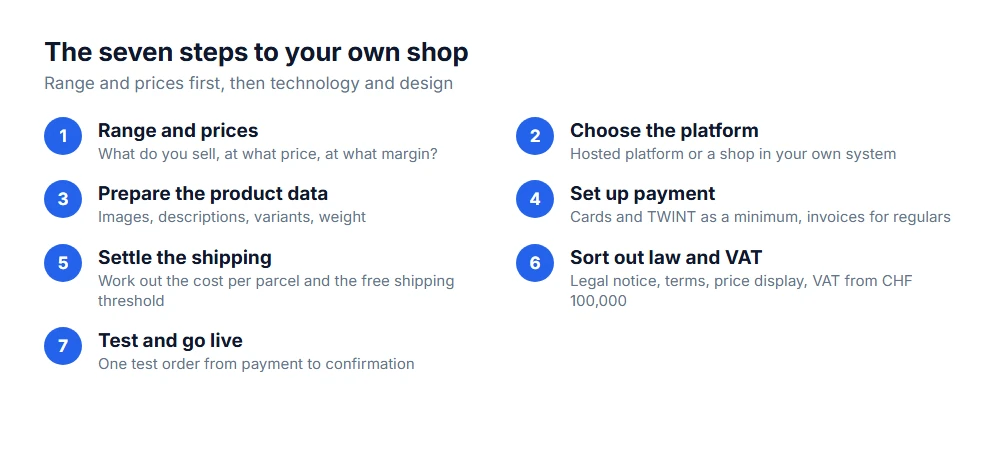
There is a simple logic to the order. Only once the range and prices are settled can you pick the right platform. And only once payment and shipping are clear is it worth working on the design.
Our timings: a lean shop with a handful of products is ready in three to four weeks. With a custom design, a larger range or a link to your inventory system, it is eight to twelve weeks. The biggest time factor is almost always the product data.
If you have no web presence at all yet, build the foundations first: domain, platform, legal texts. Our article on how to create a website covers those steps.
Which shop platform suits you?
For a Swiss SME two routes stand out: a hosted platform such as Shopify, or a shop inside your own content management system, for example WooCommerce in WordPress.
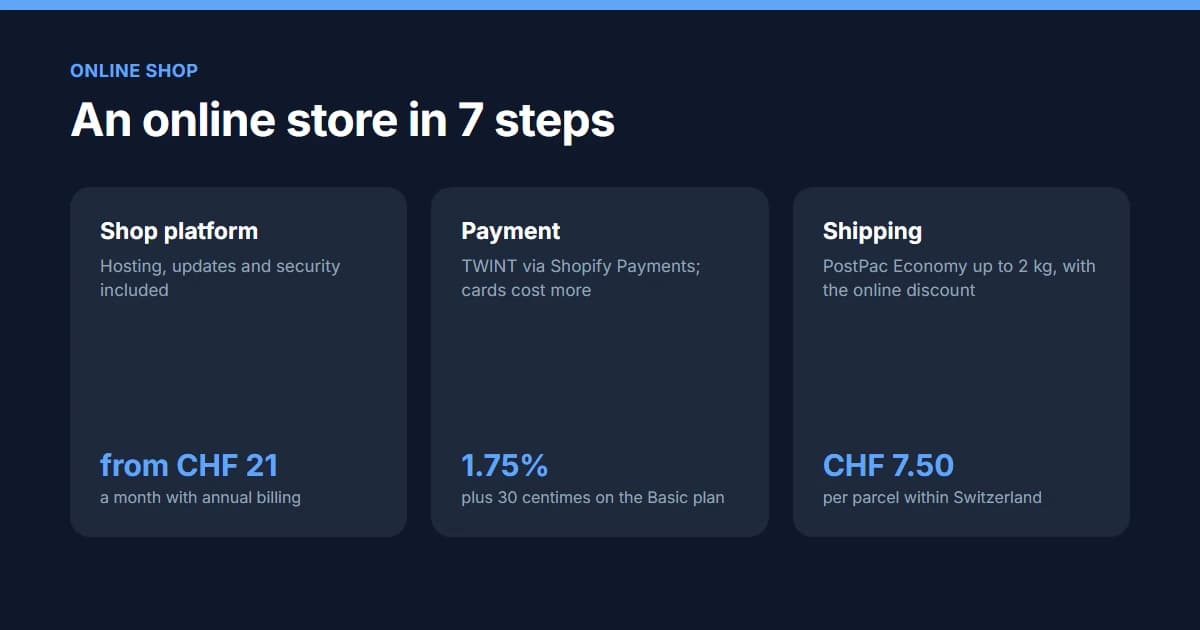
Shopify's Basic plan costs CHF 29 a month, or CHF 21 with annual billing. Grow is CHF 79 or 59, Advanced CHF 359 or 269 (Shopify pricing, checked on 15 October 2026, in German). Hosting, updates and security are included.
A shop in your own system has no monthly licence fee, but you pay for hosting, extensions and maintenance. That maths works out when you need something a platform cannot handle.
One question is worth asking before you decide: how do you get out again? Have someone show you how products, orders and customer data can be exported. A move is rarely planned and almost always urgent.
The full comparison, with the upsides and the drawbacks, is in WordPress, Shopify or custom development.
Payment methods for Swiss customers
Customers expect three things: cards, TWINT and, for regulars, an invoice. Every payment method costs something, and the differences are bigger than most people expect.
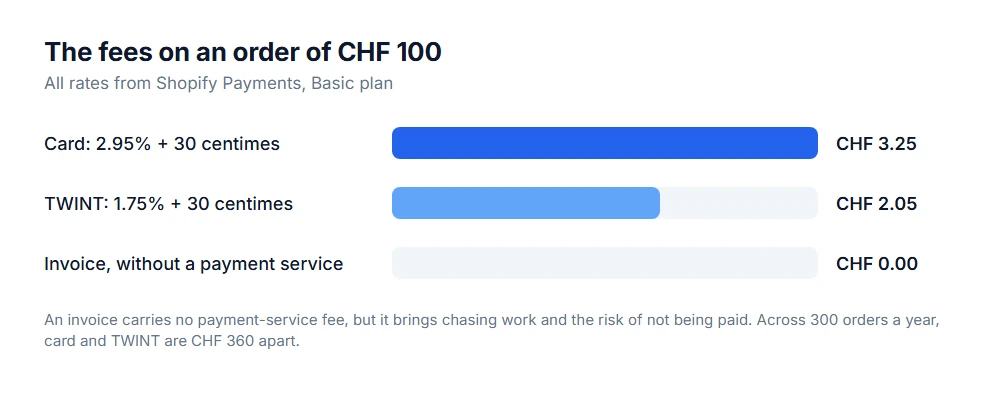
The fee depends on the payment service, not on the payment method alone. On the Shopify Payments Basic plan a card payment costs 2.95 percent plus 30 centimes and a TWINT payment 1.75 percent plus 30 centimes. On the higher plans the card fee drops to 2.75 and 2.55 percent, each plus 30 centimes. If you use an external payment provider, you pay a further 2 percent on Basic and 1 percent on Grow.
On an order of CHF 100 that means: card 2.95 + 0.30 = CHF 3.25, TWINT 1.75 + 0.30 = CHF 2.05. Across 300 orders a year the difference comes to CHF 360.
All of those rates come from the shop platform. Take TWINT directly under a contract of your own and remote transactions cost 1.35 percent, plus 30 centimes per transaction when a payment link is used (TWINT schedule of prices and services, July 2026). That means your own contract and integration, which only pays off at a certain volume.
One method missing from the Shopify Payments list for Switzerland is PostFinance. To offer it you need an external payment provider, and on the Basic plan that adds the further 2 percent. Whether VAT comes on top of these fees is set out in our article on what an online shop costs.
Shipping with Swiss Post
Swiss Post publishes its price list, and it belongs in your calculation before you start thinking about free shipping.
| Weight | PostPac Economy | PostPac Priority |
|---|---|---|
| up to 2 kg | 9.00 | 10.50 |
| up to 10 kg | 12.00 | 13.50 |
| up to 30 kg | 21.00 | 22.50 |
The amounts are in Swiss francs including VAT. Create the parcel label online and you get a discount of CHF 1.50 per parcel (Swiss Post, checked on 15 October 2026).
So a small parcel costs you CHF 7.50. Offer free shipping from CHF 100 and that is 7.5 percent of an order at that threshold, on top of the payment fee. Either you build shipping into your prices, or you set the threshold higher.
Budget for packaging material and the time spent packing as well. Neither shows up in any quote, and both cost money.
Businesses with a physical shop have one option that costs no postage at all: collection in store. It brings customers through the door, saves the parcel, and can be set up as its own shipping method in any platform.
VAT and legal texts
Four duties apply to online commerce. Anyone offering goods or services online must give clear and complete details of their identity and contact address including their email address, indicate the technical steps leading to a contract, provide a way to spot and correct input errors, and confirm the order electronically without delay (UCA Art. 3 para. 1 let. s, SR 241).
Prices. You state the price actually payable, in Swiss francs. Surcharges the customer cannot avoid belong inside that price; shipping costs may be shown separately (Price Indication Ordinance Art. 3 and 4, SR 942.211, in German).
Returns. Switzerland has no statutory right of withdrawal for online orders. The Code of Obligations grants one for doorstep sales, telephone sales and similar situations, but not for online trade (CO Art. 40b, SR 220). Many shops grant a right of return voluntarily, in which case it belongs in the terms and conditions.
VAT. You become liable from CHF 100,000 of annual turnover (Federal Tax Administration). The standard rate is 8.1 percent (VAT Act Art. 25 para. 1, SR 641.20). Plan the switch early, because it affects prices, invoices and bookkeeping at the same time.
Legal position checked in October 2026. This article is not legal advice.
What does an online store cost, and how long does it take?
Our guide prices: a simple shop starts at around CHF 1,200. With a custom design, up to a hundred products and SEO basics, the range is CHF 4,000 to 10,000.
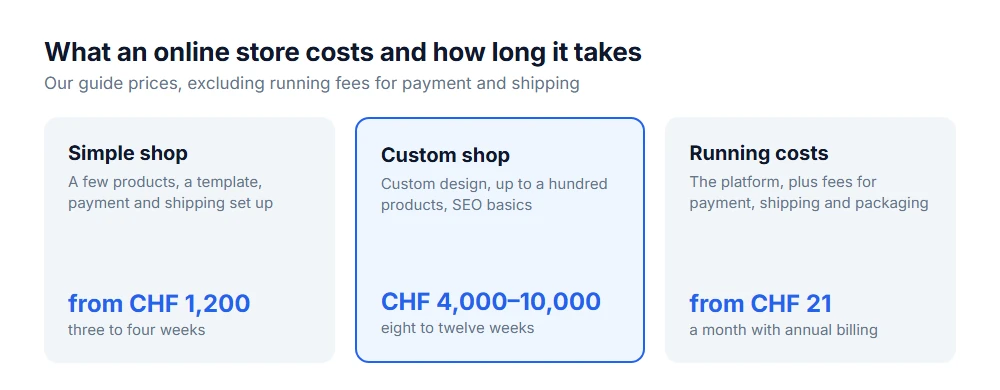
Then come the running costs, which you can work out from the figures above: the platform from CHF 21 a month, payment fees depending on your mix, shipping and packaging. Only that total shows what margin is left.
The guide prices include SEO basics, meaning clean page titles, categories and product copy that match what your customers search for. Our article on what SEO is explains what sits behind that.
A detailed breakdown by shop size is in our article on what an online shop costs.
How to get started
- Prepare ten products completely. Image, description, variants, weight. That tells you how much work the full range will be.
- Settle the payment methods. Cards and TWINT as a minimum, invoices only for customers you know.
- Do the shipping maths. Play through the cost per parcel and the free shipping threshold with the figures above.
- Prepare the legal texts. Legal notice, terms and conditions, privacy statement and the order confirmation.
- Make the first sale early. One real order teaches more than any plan: packaging, delivery times, follow-up questions.
How we build shops, from structure to handover, is described on our online shop page.
Frequently asked questions
Shopify Payments or an external payment provider?
How many products do I need to start?
Do I need my own shop if I sell on a marketplace?
Who looks after stock levels and returns?

Written by
Jonathan Lao
Managing Director, PortalWeb GmbH
Jonathan Lao is Managing Director of PortalWeb GmbH, based in Altdorf in the canton of Uri. He supports Swiss SMEs in the conception and development of corporate websites and online stores, as well as in search engine optimisation and online marketing.