
WordPress, Shopify or custom development?
Short answer
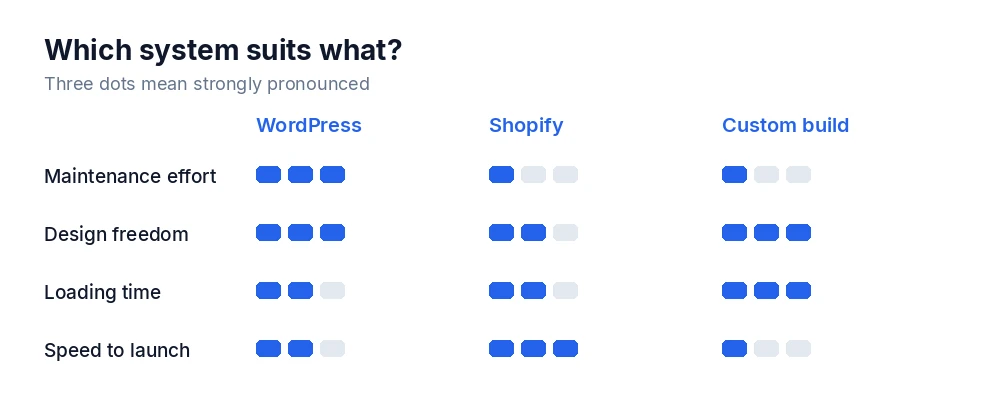
WordPress suits company websites with regular content updates, Shopify suits online stores with standard processes, and a custom build makes sense when loading speed, SEO or a connection to existing software is decisive. The biggest difference isn't the build price but the ongoing maintenance effort.
Around 43 percent of all websites worldwide run on WordPress, according to the ongoing survey by W3Techs. Concluding that it's therefore right for your project makes about as much sense as buying a minibus because it sells well.
Here's the comparison without tribal loyalty – we work with all three depending on the project.
When is WordPress the right choice?
When you publish content yourself regularly and need a system with help available everywhere.
WordPress is a content management system. It's strong when content grows: blog, references, news, team pages. The admin area is usable without prior knowledge after an introduction, and there's an add-on for practically every requirement.
That's precisely where the weakness lies too. Every add-on is third-party code that has to be maintained. A typical WordPress site has fifteen to thirty of them. If one isn't updated, a security hole opens – and compromised WordPress sites are the most common reason businesses contact us.
Costs: build CHF 1,500 to 6,000. Ongoing CHF 300 to 1,200 per year for updates, security checks and backups. That item isn't an optional extra, it's operating cost.
Suits: company websites with a blog, businesses with frequent content changes, projects with unusual requirements.
Doesn't suit: when nobody takes on maintenance. An unmaintained WordPress site is a liability after two years.
When is Shopify the right choice?
When you sell products and don't want to deal with technology.
Shopify takes care of the things that cause most trouble in e-commerce: payment processing, shipping rules, tax rates, security updates. All of it runs in the background, and when something breaks it's Shopify's problem.
The price for that is renting rather than owning. On the Basic plan Shopify costs CHF 29 a month, or CHF 21 with annual billing. Fees per payment come on top: with Shopify Payments 2.95 percent plus CHF 0.30 for Swiss cards and 1.75 percent plus CHF 0.30 for TWINT (Shopify). At CHF 100,000 annual turnover that's CHF 1,750 to 2,950 depending on the mix, plus CHF 0.30 per payment.
If you use another payment provider on Shopify, Shopify charges an extra 2 percent on the Basic plan. The full calculation is in How much does an online shop cost in Switzerland?
The second limitation is design freedom. Much is possible, some isn't, and you only discover where the boundary runs when you hit it.
Costs: build from around CHF 1,200, or CHF 4,000 to 10,000 with custom design. Ongoing from CHF 348 per year with monthly billing, from CHF 252 with annual billing, plus fees per payment.
Suits: stores up to a few hundred products, standard processes, anyone wanting to start quickly.
Doesn't suit: unusual pricing logic, tight integration with an inventory system, very large product ranges.
When is a custom build worth it?
When speed, search engines or a connection to existing software is decisive.
A custom-built site has no third-party add-ons, no database queries for content that never changes, and no code you don't need. The result is loading times a builder or an add-on ecosystem can't reach – and loading time is a confirmed ranking factor.
The second strength is the attack surface. Where there are no add-ons, there are no add-on vulnerabilities. Ongoing maintenance effort sits considerably below WordPress.
The downside is the higher initial investment and dependence on someone who understands the code. So before commissioning, ask which technology is used. Established tools like Next.js are so widespread that any web developer can work with them. A homemade solution would be a genuine concentration risk.
Costs: build CHF 3,000 to 12,000. Ongoing CHF 0 to 300 per year for hosting.
Suits: SEO-driven projects, multilingual sites, integrations with existing systems, businesses with a long horizon.
Doesn't suit: small budgets, very frequent structural changes by you.
What does each system cost over five years?
The build price is only part of the calculation. Over five years, for a normal company website, it looks like this:
| WordPress | Shopify | Custom build | |
|---|---|---|---|
| Build | 3,000 | 3,000 | 5,000 |
| Maintenance 5 years | 3,000 | 0 | 500 |
| Licences 5 years | 500 | 1,260 | 0 |
| Hosting 5 years | 750 | 0 | 500 |
| Total | 7,250 | 4,260 | 6,000 |
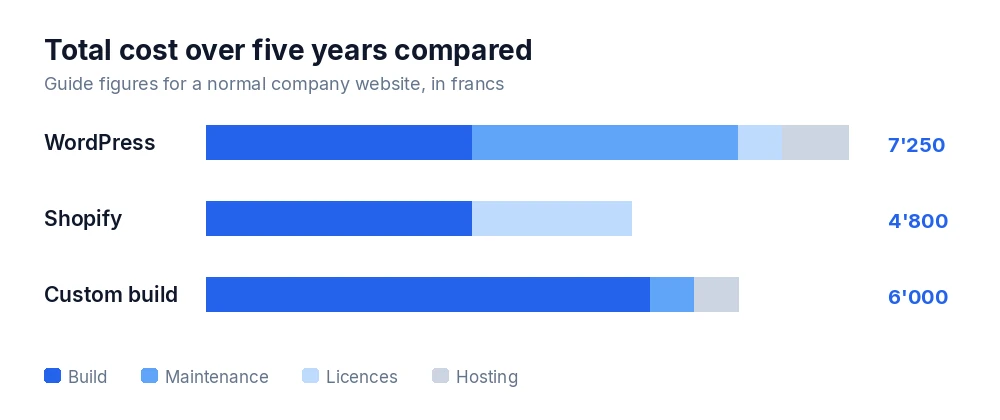
The figures are guide values and shift considerably by project. Shopify is calculated on the Basic plan with annual billing, so 5 × 252 = CHF 1,260. Fees per payment come on top, and they overtake everything else as turnover grows. With WordPress much depends on how many add-ons are in use.
What the table shows: the build price alone says little about the total cost.
What is possible with a WordPress website?
Practically everything an SME needs – and that is both blessing and curse.
Add-ons make booking systems, member areas, multilingual sites, forms with conditional logic and connections to accounting software possible. A ready-made solution exists for most requirements, which saves development time.
The catch: every add-on brings its own code, its own updates and its own vulnerabilities. A site with thirty add-ons isn't thirty times more powerful, it's thirty times more maintenance-intensive. We therefore recommend keeping the number deliberately small and checking, for central features, whether a lean custom solution wouldn't make more sense.
A rule of thumb from practice: under ten add-ons a WordPress site stays manageable. From twenty, maintenance becomes a cost factor of its own, and from thirty you should question the platform choice fundamentally.
How do I tell which system a site is built with?
Surprisingly many people ask – usually to check what competitors use.
For WordPress a look at the source often suffices. Right-click, "View page
source", then search for wp-content. If it appears, it's WordPress. A second
clue is the address /wp-admin – if a login shows up there, the case is clear.
Shopify you recognise by cdn.shopify.com in the source. With custom builds it's
harder, because there's no uniform fingerprint.
More practical are browser extensions such as Wappalyzer, which show it automatically.
Which question really decides?
Not "which system is better", but who maintains the site in three years.
If nobody takes on maintenance, WordPress is the worst choice despite being the most widespread system. If you want to grow and margin matters, Shopify fees eventually become an issue. If Google is to be the main source of enquiries, much speaks for a custom build.

We work with all three and recommend what fits the situation. Our own site, by the way, is a custom build with Next.js – for exactly the reason above: as an agency selling SEO, a slow site would be hard to explain.
Which system suits your project we're happy to clarify without obligation. Details of our services are on the page for business websites, and if it's about a store, under ecommerce website development.
Frequently asked questions
Is WordPress free?
How secure is WordPress?
Can I switch from WordPress to Shopify or the other way round?
Is a custom build a concentration risk?
Which system is best for SEO?

Written by
Jonathan Lao
Managing Director, PortalWeb GmbH
Jonathan Lao is Managing Director of PortalWeb GmbH, based in Altdorf in the canton of Uri. He supports Swiss SMEs in the conception and development of corporate websites and online stores, as well as in search engine optimisation and online marketing.